
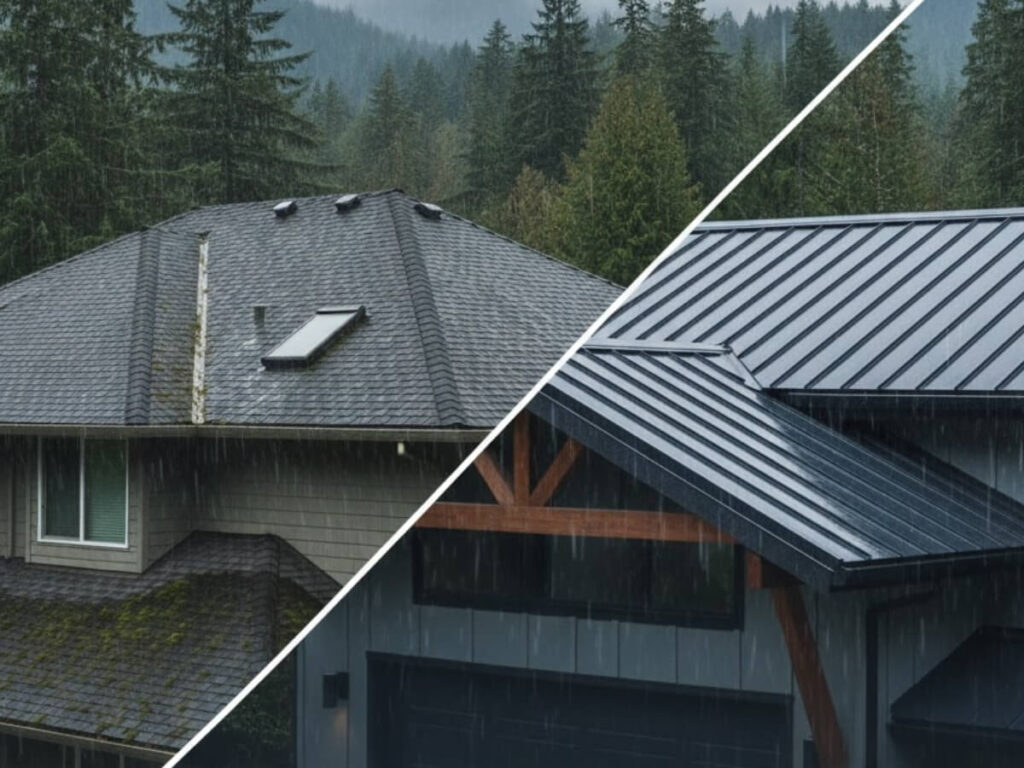
The Pacific Northwest is beautiful—and tough on roofs. Frequent rain, overcast days, tree cover, coastal salt near the Sound and coastlines, and the occasional wind event all shape what you’ll spend over the next two decades. This article breaks down what really drives 20-year cost of ownership for asphalt shingles vs. metal roofs in the PNW so you can plan with clear numbers, realistic maintenance, and fewer surprises.
What 20-Year Cost of Ownership Means Here
Your 20-year roof cost isn’t just what you pay on day one. In the PNW, it blends upfront install, maintenance and cleaning, repairs after storms, energy use across mild summers and cool winters, and value at resale. The climate—and your site (sun or shade, trees, proximity to salt air)—matters as much as the material.
Climate Pressures You Must Budget For (PNW Reality)
Rain + Shade = Moss Pressure
Moss loves cool, damp, shaded surfaces. If you have trees nearby or a north-facing slope, plan on periodic cleaning and moss control to protect shingles, flashing, and edges. Letting moss lift shingle tabs shortens service life and invites leaks. Trimming back shade and keeping debris off the roof are essential preventive steps.
Wind And Storm Bursts
When gales push rain under laps and through weak seals, repairs (and sometimes early replacement) show up as unplanned costs. Selecting roof coverings and installation methods tested for uplift and using enhanced fastening details lowers this risk on both asphalt and metal systems.
Coastal Salt And Corrosion (For Metal Near Marine Air)
Salt spray accelerates corrosion on unprotected steel. Along our coasts and in bays, choose metal systems and coatings rated for marine exposure and keep surfaces able to drain and dry; standing debris traps moisture and speeds coating breakdown.
Summer Heat And Cool Roofs
Reflective “cool color” options on steep-slope roofs can trim summer cooling use. In mixed climates like the PNW there can be a small winter heating penalty, but net annual savings are still possible depending on house and site.
The Cost Categories To Track
Upfront Install
Material + labor + tear-off/disposal + underlayments/flashings + ventilation upgrades.
Maintenance & Cleaning
Regular roof washing where moss pressure is high, gutter service, and sealant/fastener checks.
Repairs & Risk
Storm-driven leaks, impact damage, edge repairs, valley and penetration fixes.
Energy
Cooling savings from reflective surfaces; minimal but real in low-AC homes near Puget Sound and Willamette Valley.
Value At Sale
Project resale value recouped in our Pacific region (a helpful reality check).
Asphalt vs. Metal—20-Year Picture for the PNW
Upfront Cost & Resale Value (Pacific Region Context)
Independent regional data show typical project costs and value recouped when you sell:
- Asphalt shingle replacement (Pacific): Average job cost $33,244; average resale value $19,746 (≈ 59.4% recoup).
- Metal roof replacement (Pacific): Average job cost $54,580; average resale value $33,802 (≈ 61.9% recoup).
So metal often starts higher but tends to recoup slightly more at sale in our region. If you expect to sell within the time horizon, factor those percentages into your net ownership cost.
Note on overlays vs. tear-offs: In some jurisdictions and conditions, a new roof can be installed over an existing roof covering; other cases require full removal. Local code and roof condition govern whether a recover is allowed. Always confirm before assuming overlay savings.
Service Life & Maintenance Rhythm
- Expected service life (nationally reported ranges):
• Three-tab asphalt: ~20 years
• Architectural asphalt: ~30 years
• Metal: ~40–80 years (product and exposure dependent)
Longer service life smooths costs over time and reduces the chance you’ll need a second roof inside the 20-year window. - Moss management (asphalt especially): In our climate, periodic cleaning and treatment (e.g., zinc sulfate or potassium-salt products) plus more sunlight on shaded slopes help keep moss from lifting shingle edges. That routine is a common line item for PNW asphalt owners and still advisable for metal in heavy shade.
- Metal maintenance: Expect occasional inspections for fasteners, sealants, and paint finish—especially in marine zones where cleaning and the right coating system preserve performance. Good drainage and clearing debris reduce corrosion risk and extend coating life.
Weather Performance & Risk Costs
- Wind & hail guidance: Selecting steep-slope coverings and assemblies with appropriate wind ratings and (where relevant) impact ratings helps curb unplanned repair costs across the years. Both asphalt and metal assemblies can be specified and installed to meet higher wind demands.
- Fire performance: Steep-slope roof coverings and assemblies are rated Class A, B, or C for exterior fire exposure; Class A offers the highest level. Both asphalt fiberglass shingles and many metal roof assemblies are available with Class A ratings when installed per listed assembly details. That matters for ember resistance on the drier side of the Cascades and in forested sites.
Energy & Comfort Over Two Decades
Reflective options for steep-slope roofs can cut summer heat gain. In the PNW’s mixed climate, that tends to be a modest annual savings (bigger for sun-exposed homes with AC), and any winter tradeoff is often smaller than summer benefits. If energy payback is a goal, look for products with documented reflectance and emittance values.
A Simple 20-year Scenario (To Frame Your Decision)
Assumptions (replace with your home’s specifics during an estimate):
- 1-story home with a medium-complexity, ~2,000-sq-ft roof; typical PNW shade on at least one slope.
- You’ll maintain as recommended (debris cleared, gutters serviced, moss treated where needed).
- No catastrophic events.
Asphalt shingles (architectural)
- Year 0 install: Use the Pacific region average as a planning anchor (see above).
- Years 1–20 maintenance: Plan periodic moss treatment/cleaning (frequency depends on shade), plus occasional shingle/flashings repairs after wind-driven rains.
- Service life crossover: If you stay past 20 years, you may be entering replacement territory for asphalt, which increases long-run cost risk.
Metal roof (painted steel or aluminum, steep-slope)
- Year 0 install: Higher upfront than asphalt (see Pacific averages).
- Years 1–20 maintenance: Visual inspections, debris clearing, and periodic checks of sealants/fasteners; cleaning is still smart in dense tree cover.
- Service life crossover: A 20-year window is well inside typical metal life, which reduces replacement risk within the horizon. In marine zones, confirm coating system selection and cleaning to control corrosion.
Resale reality check
If you sell during the window, the Pacific region’s measured recoup values (~59% asphalt vs. ~62% metal) can narrow the practical cost gap at the time of sale.
Which Roof Pencils Out Over 20 Years?
- Choose asphalt if lowest day-one cost matters most and you are prepared for regular moss control plus occasional storm repairs. It’s often the budget-friendly route, especially if you expect to move before the 15–20-year mark.
- Choose metal if you want longer service life, fewer replacement risks inside 20 years, better summer reflectivity potential, and slightly stronger resale recoup in our region. It’s a bigger initial check, but lower probability of needing a second roof within the window.
How Intercrus Roofing Helps You Decide
Every PNW home has its own mix of shade, tree litter, wind exposure, and coastal influence—and that’s exactly what drives real 20-year costs. Intercrus Roofing will inspect your roof and site, model your 20-year path for asphalt and metal (maintenance rhythm, energy considerations, and code constraints), and give you a clear, line-item plan so you can choose with confidence. If you want a roof that fits your budget today and your plans for the next two decades, our roofing contractors is ready to help—start with a quick assessment and we’ll build your options from there.