
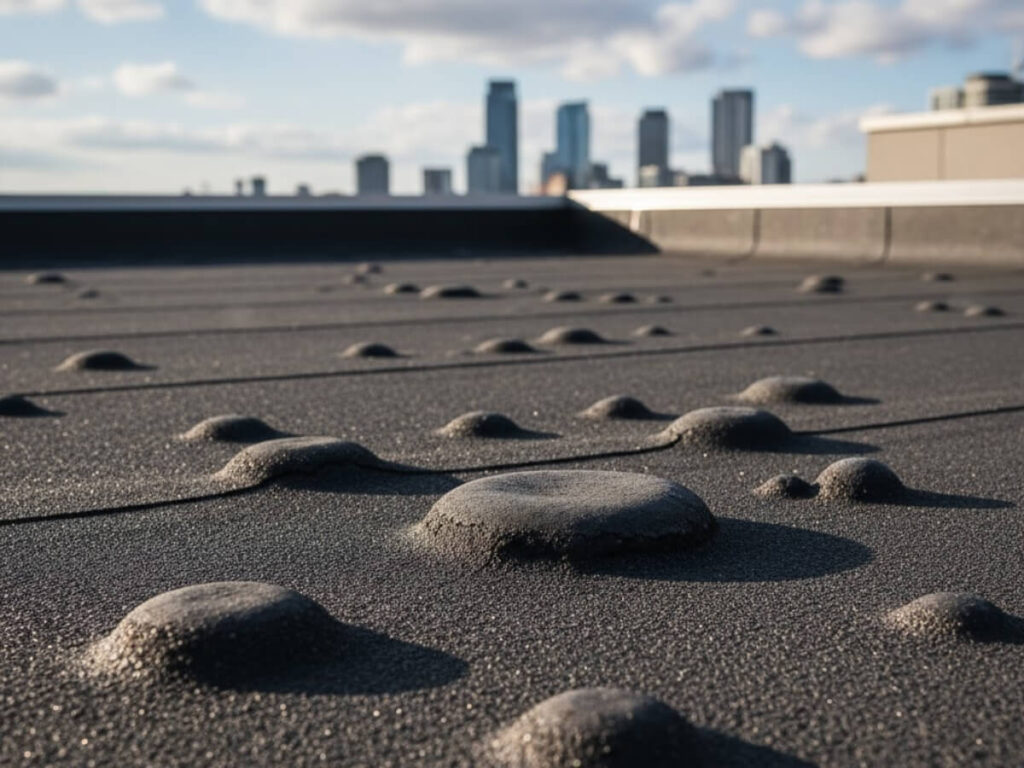
Flat roofs are built in layers. When air or moisture becomes trapped between those layers and expands under heat, the membrane can lift and form blisters. Left alone, some blisters stay cosmetic; others tear, invite leaks, and shorten the roof’s service life. Understanding why blisters form—and how to stop them—is the key to longer-lasting, lower-risk roofs.
What is a Roof Blister?
How A Blister Forms
A blister is a raised, dome-shaped area where the roof membrane is locally de-bonded from what’s beneath it. Trapped air or vapor expands during daily heating and cooling, creating a “breathing” cycle that pumps the pocket larger over time.
Where Blisters Appear
Blistering can occur in built-up (BUR) and modified-bitumen systems, single-ply membranes, and spray polyurethane foam (SPF) roofs. The mechanism is similar—voids plus heat—but details vary by system (for example, SPF can blister from gas or moisture during application).
Main Causes of Blistering
Trapped Moisture In The Assembly
Sources of moisture: Materials installed in damp, rainy, or dewy conditions during application, leaks at penetrations, and vapor released from interior spaces (or from curing structural concrete) can all introduce moisture that later expands into blisters. Concrete decks are notorious for releasing large amounts of water as they dry; without a proper vapor retarder, that moisture migrates upward into the roof system.
Vapor drive and missing/weak vapor control: In certain climates and occupancies, interior vapor pressure drives moisture toward a cool roof layer where it condenses. Using an appropriate vapor retarder—distinct from an air barrier—reduces diffusion and condensation in low-slope roofs. Selection should reflect climate and interior conditions, not a one-size-fits-all approach.
Adhesion And Installation Errors
Blisters often trace back to voids created during installation: inadequate adhesive or asphalt coverage, contaminated or dusty substrates, laps not rolled in, or application at the wrong temperatures. Good technique and correct temperatures for hot asphalt or adhesive are repeatedly shown to reduce blistering.
Thermal Movement (“Breathing”)
Daily heating expands the air/vapor in a void and softens asphaltic bonds, increasing internal pressure; cooling contracts it. This cycle grows blisters and can stress nearby seams. The phenomenon is well-documented in BUR and modified-bitumen research.
Substrate And Design Factors
Poor drainage (ponding), incompatible layer permeances that trap moisture, and a lack of venting over closed-cell foams increase blister risk. Thoughtful drainage design (primary and overflow) and smart vapor control reduce the conditions that blisters need to form.
How to Diagnose Blisters Correctly
Start With A Careful Visual Survey
Walk the roof safely and note size, location, surfacing loss, proximity to seams and penetrations, and any foot-traffic paths. These details guide whether a blister is likely cosmetic or a priority repair.
Use Non-destructive Testing (NDT) The Right Way
Infrared thermography (IR): IR surveys, performed under proper sunset/evening conditions, map temperature differences that reveal wet insulation and discontinuities under the membrane—useful for finding moisture associated with blistering. Always verify anomalies with probe or test cuts before committing to repairs.
Confirm with core cuts when needed: Small, strategic test cuts tell you what each layer is doing (wet, dry, bonded, voided), so the repair plan targets the real cause.
Preventing Blisters — Practical Steps That Work
Design For Moisture Control From Day One
- Do a vapor analysis: Consider climate zone, interior humidity, and roof color. Choose a vapor retarder with the right permeance—not too little, not too much—to keep condensation out of the roof layers.
- Over closed-cell foams, allow venting when needed: Venting layers can relieve gases and water vapor that otherwise create a trap between impermeable layers.
- Respect wet concrete: When roofing over concrete decks, plan for the deck’s drying or use an effective vapor retarder; otherwise, vapor will migrate up and feed blisters.
Keep Materials And Substrates Dry
- Store smart: Keep rolls and boards off the deck and covered; don’t install damp products.
- Check moisture: Use moisture meters where appropriate; seal porous decks and use coverboards to buffer irregularities. Guidance from long-standing research points to dry materials and substrates as the top blister-reduction tactic.
Follow Application Parameters Precisely
- Temperatures matter: Apply hot asphalt or cold adhesives within specified temperature windows; avoid overheated asphalt that oxidizes and under-heated asphalt that won’t wet-out.
- Roll laps and avoid voids: Full contact between plies and at seams reduces air pockets that can grow into blisters.
- Watch the weather: Pause work for rain, dew, or condensation risk. For SPF and coatings, avoid spraying into dew or onto moist substrates—this is a common blister trigger.
Design Drainage And Protect Traffic Zones
- Drain the roof: Properly sized primary and overflow drainage minimizes ponding that heats and stresses membranes.
- Control traffic: Use walk pads and service paths; uncontrolled foot traffic can break surfacing over blisters and turn a cosmetic issue into a leak.
Inspect And Maintain On A Schedule
- Keep water moving: Clear drains and scuppers, especially after storms.
- Fix small cuts fast: Prompt patching removes moisture pathways that feed blister formation.
- Use IR periodically: After severe weather or before renewals, an IR check plus targeted cores helps you repair only what needs it.
Repair or Leave It Alone?
When Monitoring Is Reasonable
Industry guidance and research agree: unopened, stable blisters that aren’t in seams or high-traffic areas are often cosmetic and can be monitored. Many can persist for years without leaking—so long as surfacing remains intact and reinforcement isn’t exposed. Document their locations and watch for change.
When To Repair Now
Consider repair if a blister has opened, shows surfacing/granule loss, exposes reinforcement, sits in a seam, or lies in a walkway/service zone where it’s likely to rupture. Widespread blistering can also signal systemic moisture or adhesion issues that merit broader intervention.
What A Proper Repair Looks Like (System-dependent)
For asphaltic membranes, a typical repair involves cutting and lifting the blistered area, drying or removing any wet material, re-bonding with compatible adhesive/asphalt, and installing reinforced patches with feathered edges and restored surfacing. For SPF, follow system-specific guidance to remove the blistered to sound foam and rebuild with compatible foam and coating. In every case, correct the moisture or adhesion problem that created the blister, or it will return.
Frequently Asked Blister Questions
Are Small Blisters An Emergency?
Usually not. If the membrane is intact and the blister isn’t in a seam or walkway, monitor it and focus on drainage and moisture control.
Do IR Scans “See” Leaks?
IR maps temperature differences that correlate with wet insulation; it doesn’t directly see water. Professionals verify with probes or test cuts before repairs.
Will A Vapor Retarder Stop Blisters?
It can prevent one major cause—vapor diffusion and condensation—but only when selected correctly for the building and climate and integrated with air-sealing and drainage.
Protect Your Flat Roof With Intercrus Roofing
Blisters tell a story about moisture, adhesion, and heat. The right response begins with the right diagnosis, followed by targeted repairs and practical prevention. Intercrus Roofing can inspect your flat roof, perform or coordinate non-destructive testing, pinpoint the root cause, and implement repairs that address both the symptom and the source. We also help owners build simple maintenance routines—clearing drains, resealing details, and planning periodic assessments—so small issues never become big ones. If you’ve noticed bumps, bubbles, or soft spots on your roof, contact our roofing contractors for a clear plan to keep your building dry, efficient, and durable.